Saturday, February 15, 2025

2024 Awards

The 2023 red blend of mostly Cabernet Franc mixed with Merlot and Cabernet Sauvignon won gold at the North Carolina 2024 State Fair wine competitions, scoring a total of 18/20.


Sunday, December 18, 2022

2021/2022 vintage results and assessment.


 2021 survived an early frost that devastated some local wineries. But we didn’t escape without a scratch. Later in the year, wasps went after a good amount of the grapes which caused damage and some fermentation problems. The wine had heavy levels of H2S as we didn’t add enough yeast nutrient. So how this wine turned out over a year later after adding Reduless and Noblesse to remedy is interesting. Clearly this didn’t resolve all the issues. But after a couple hours of decanting the wine was very drinkable much to my surprise. There’s still a bit a mustiness to this wine but maybe after time in the bottle … who knows. 

2022 went off without a hitch. Netting was installed to protect grapes against wasps and birds. Rains were projected to come  in early; every winery was picking a few weeks earlier than they would have liked to. But after adding some sugar, ph came in okay. We used Muse yeast to prevent H2S with a lower ferment temp below 77 degrees. Viognier fermented temperature controlled at around 60 degrees. I bought a Flextank to age our reds and blended 70% Cabernet Sauvignon, 15% Cabernet Franc and 15% Merlot. This is my first time attempting a blend so I defer to a “boiler plate” recipe for a Bordeaux style. 

Now we are at a point where 30 gallons are coming and and more on the way next year. I opened up a few bottles of great wines in the meantime while we wait for 2022 to age in the Flextank with French oak for 12 months. 

Sunday, August 15, 2021

Summer 2021

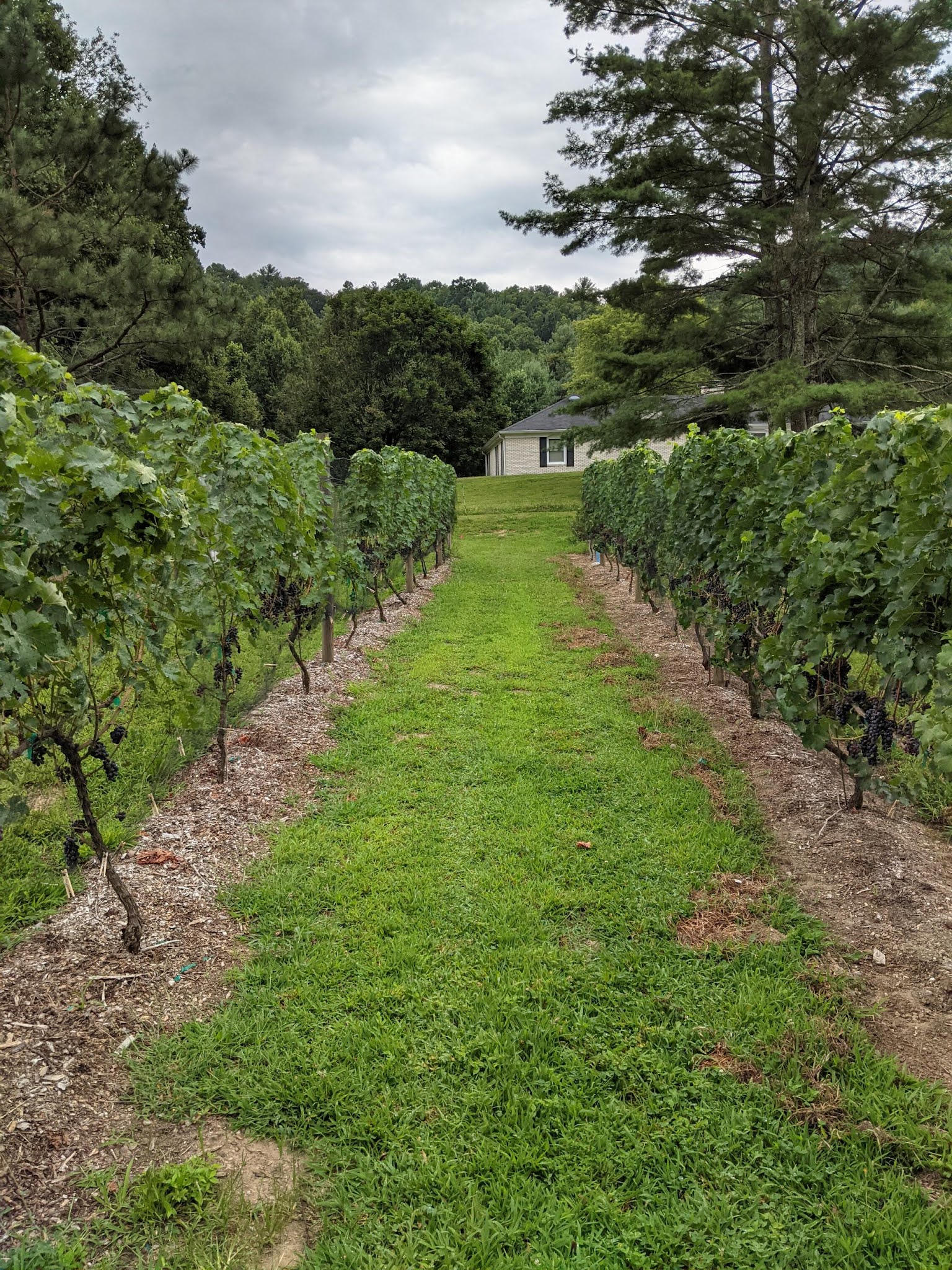
 Filling in much better this year and vines are starting to look mature.


Wednesday, May 12, 2021

Good books for grape growing / winemaking


 I’ve read a few books on growing grapes and winemaking. Here are a few I’d recommended in no particular order:


Great book for technical aspects of making wine.


The book that inspired me to plant a vineyard, found on an old barrel at Benmarl winery when I knew little to nothing about wine or grapes. Miller was an artist that grew grapes as a hobby then later turned it into his profession. Includes many great illustrations documenting his journey, filled with interesting characters, struggles, success and travels to Burgundy. A great read for anyone interested in wine.


Great project ideas for building winery equipment. The ridding rack was particularly useful for making sparkling cider.


Not just a book about building a do it yourself cellar but an entertaining insight to many things oenophile.


The single most useful book I’ve read for home grape growing. I often reference it.


A really interesting insight into winemaking and some of the more intellectual and philosophical aspects of it. 

A densely packed book filled with the history of wine grapes and wine making dating many thousands of years.

Interesting read on the muscadine winemaking business in early North Carolina, the failed early attempts to grow vinifera and it’s resurgence in the 1970s much credited to Biltmore Estate.


Tuesday, May 11, 2021

2020 wine assessment and 2021 plans


I haven’t updated the winemaking portion of this blog in detail since the yields were only two gallons. (This year should be at least six and will greatly increase over time) Some sugar was added to bring the wine and acid into balance. This was because the grapes were picked earlier than they should have been. You can rely strictly on pH but in the end picking to ripeness comes down to experience and preference. This year we will increase the hang time to a higher brix.

Tasting both the merlot and cabernet, firstly the merlot was very fresh. The color was excellent. There was no oak treatment which generally contributes more to a sense of fresh fruit when the acid is in balance. It’s an average wine but it does display its varietal well and has notes of fresh red cherry and a sense of cherry cordial which is a character I notice in merlots from the area. But, the finish is short, tannic structure is lacking, and there isn’t much complexity.

The Cabernet displayed some sulphur flaws that wafted away after decanting. (A few of the bottles have sediment.) This wine I found to be more drinkable although it has a much lighter character than bolder California cabernet and lacks the complexity of good French Cabernet. Tannic structure was very lacking and skin contact may have to be extended. As the grapes get older and the winemaking improves hopefully so will the quality.


Last years grapes were completely ruined by frost, which struck again this year and wiped out many of the states crops. Fortunately we only lost ten percent. There are many buds on the merlot already and the Cabernet is coming in.

Plans for this year - I ordered more Cabernet franc from Wiemer vineyard and winery in finger lakes, NY. We will be installing new trellises for these grapes

Total vines - 154 


.


Monday, January 27, 2020

Winter 2020

Establishing four more rows this year; one additional row each of Cabernet Sauvignon and Merlot. Two rows of Cabernet franc.


Tuesday, October 22, 2019

Fall/Winter 2019

After fermentation, the wine is racked and enters cold stablization at a refrigeration temperature of 40 degrees f.

The purpose of this is prevent any reaction in the wine from occurring between tartaric acid .and potassium. After fermentation, but prior to bottling, cold stability (chilling the wine near freezing)  is conducted to prevent the tartaric salt crystals from forming after bottling that can shift the ph. Since there's only a few gallons of wine this year, they fit easily in a fridge. After a couple of months, the wine will be racked and stored at 55 degrees for six months or more before bottling.

I did not add malolactic culture to the wine so it will have to happen naturally if it happens at all.

Mulch is also added to the vineyard rows to limit weed growth.

Plans for next year: an additional row of cabernet sauvignon and merlot are ordered for planting next spring. This will effectively double the output of red wine. Viognier ripened nicely this year but has been so slow to establish that I'm leaving it to one row.


Wednesday, September 18, 2019

Fall 2019

First grape harvest began this year. Merlot and Cabernet Sauvignon picked on Sept 9th. Merlot @ 23 brix 3.35 ph Cabernet @ 24 brix 3.5 ph.

Yield - Merlot 1 gallon
Cabernet Sauvignon - 1.5 gallon
Viognier - not harvested 

Yeast - bdx Bordeaux 


Below: ph meter for testing ph and tA


Tuesday, June 11, 2019

Summer 2019


Most vines now are in the third year. A few merlot and Cabernet vines died from disease the year prior and were replaced last year. Viognier continues to be slow to establish. 


Thursday, July 27, 2017

Summer

The vines are doing better this year due to a regular spray schedule. Mancozeb and sulfur sprays for fungacide, and Sevin insecticide.

Below is a 101-14 Millardet et de Grasset that ended up growing outside of the merlot graft. Next year, this will be regrafted with Merlot scions.

Below that is a healthy Merlot vine grafted onto 101-14 rootstock. You can see the difference in vigor between the vinifera and its rootstock.

One change that's been made to the vineyard was to fill the rows in with clover and native grasses. Rainfall started to create too much erosion.

With continued growth this year, the follow year should begin to produce grapes on some of the vines.


Wednesday, January 11, 2017

Winter

Winter comes and the leaves have fallen. The vines go dormant, green shoots turn woody, and buds remain to grow in the next year. Most of these vines have grown well, but to create a strong root system for the next year, they will be pruned back to two buds per trunk. The roots will put all of their energy into these buds and create cordons for the following year.


A few vines grew well enough that vines could be tied to the wire as cordons. For most that did, there was only enough vigor to leave one. For a few, there was enough growth to leave two, which will be the final shape of each vine as it continues to grow and mature.

Saturday, December 10, 2016

Fall.

Leaves have fallen for the year. Any near the rows are raked and burned to kill any mildew that could remain.

Friday, September 9, 2016

Disease


Almost all of the vines suffered from what looks to be like downy mildew. The vines weren't sprayed after heavy rainfall and the issue went unchecked. Most of the old growth leaves were damaged. I purchased a biofungacide from southern ag which seems to be preventing any spread of the disease. A more rigorous spray schedule will be put together for the next season.


Tuesday, August 30, 2016

August Pruning


Some of the growth is pruned off vines that were vigorous, and trunks are tied to establish cordons.

Cover crops between rows (white clover, this year) is filling in. This will provide nitrogen after tills.


Wednesday, August 3, 2016

Vine Training


Additional wires are being added to create a new training system called vertical shoot positioning. This system is being used more predominantly for vinifera in growing regions in the state such as Yadkin Valley

The trellis was originally designed as a mid wire cordon, since it's simplier and less costly, but it is not as suitable for the varieties being grown. VSP maximizes sunlight exposure, creating more of a hedge than a canopy as the foliage is tucked between sets of wires.

Monday, August 1, 2016


July 2016

Several trunks have already become vigorous enough to begin training on the 30 inch wires. They are tied to the wire to establish a trunk for the following season.

 We planted roses on the ends of the rows. Roses and grape vines are suspect to the same diseases, and roses act as an early warning for fungal disease, but for a vineyard this small, they're mostly cosmetic.

June 2016

Vine growth has turned out to be quite vigorous. In short time, many vines have neared the bottom wire and will continue upward unless tied and trained to wires. We are installing a VSP system which will be set at 30 inches for the cordons and each vine will have two trained trunks, left and right. We've started to plant white clover between rows as a nitrogen producing and weed reducing cover crop.

Currently, the vines are being sprayed with sulfur applications to control mildew. An insecticide had to be used to deal with Japanese beetles that were starting to eat away the foliage.

May 2016

A young vine begins to grow out of the graft union a few weeks after planting.

Digging holes and planting vines, 39 vines in total. In addition to being planted, a dirt mound must also be placed over the graft union to protect it.

I used Blue-X grow tubes to jump start vine growth and keep it contained. I was short two tubes and it was an opportunity to see the effectiveness of the tubes. Vines with tubes grew significantly higher up to the wire than the two without.


April, 2016

Vines have arrived from Double A vineyards and will be prepared for planting. The three varieties I decided on were viognier, merlot, and cabernet sauvignon, all which are currently recommended varieties from North Carolina State Univerity's Agricultural Institute.

I decided on rootstocks 101-14 for merlot and cab sauv and 3309 for viognier. Both are relatively low vigor stocks. Since 3309 is prone to slightly more fruiting, and viognier is known for smaller yields, my hope is that this stock may help push the yield slightly. Time will tell.


Unpacking the vines.


Soaking the vines prior to planting.